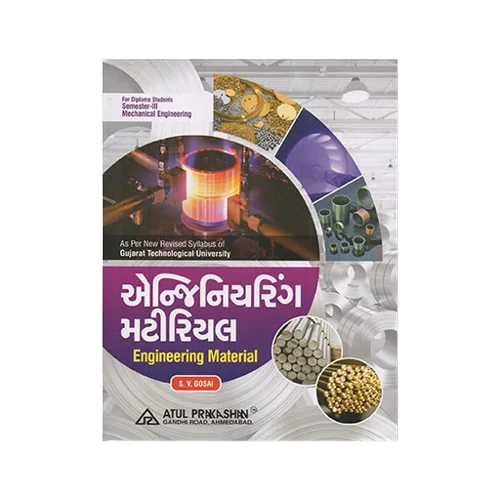
Engineering Material
Get the full GTU study material, English & Gujarati textbook PDFs, syllabus curriculum, and solved previous year question papers.
Engineering Material Syllabus — Unit-wise Content
The official GTU curriculum for Engineering Material (subject code 4300020) as prescribed for MECHANICAL · Semester 3 divides the course into 6 units, covering 26 listed topics. The unit-wise breakdown below is read from the GTU syllabus document for this subject code, so you can check what the course actually covers before deciding which papers to attempt.
Download the official syllabus PDF (4300020)Unit 1 Engineering Materials
- 1.1. Types of bonds, construction and characteristics of electrovalent, covalent, coordinate, hydrogen and metallic
- 1.2. Intermolecular force of attraction
- 1.3. Molecular arrangement in solids, liquid and gases
- 1.4. Structure of solids i. Concept of crystalline structure. ii. Structure of metal-unit cell, BCC, FCC and HCP. iii. Examples and properties of metallic structures
- 1.5. Physical, mechanical chemical, electrical, electromagnetic and thermal properties of Material.
Unit 2 Phase Diagrams
- 2.1. Equilibrium diagrams. i. Concept, definition and need. ii. Alloys-major elements, reasons to add and important effect on material properties. iii. Cooling curve-concept and method to plot.
- 2.2. Solidification of metals i. Concept. ii. Crystal, grain, grain boundaries and dendritic solidification. iii. Effect of cooling rate on material properties. Engineering Material Course Code: 4300020
- 2.3. Time Temperature Transformation curve- (TTT curve). i. Need and application. ii. Steps to construct TTT curve
- 2.4. Iron carbon equilibrium diagram. i. Concept, need & characteristics. ii. Definition of the terms used.
- 2.5. Heat treatment processes. i. Heat treatment processes. (Annealing, normalizing, carburizing, case hardening, hardening, tempering, spherodising, nitriding, tempering, stabilizing, etc.). Methods, parameters and changes in properties. ii. Types of quenching mediums, their properties and applications.
Unit 3 Metals And Its Alloys
- 3.1. Classification of metals.
- 3.2. Ferrous metals i. Classification. ii. Steels-types, composition, properties, applications. (For Plain carbon steel, alloy steel including stainless steel and cast iron.)
- 3.3. Nonferrous metals i. Classification. ii. Types, composition, properties and applications. (For Copper, copper alloys, Aluminum and Aluminum alloys.)
Unit 4 Non-Metallic Materials
- 4.1. Introduction and classification of non- metallic materials.
- 4.2. Classification of Polymers on basis of Thermal behavior (Thermoplastics & Thermosetting).
- 4.3. Properties and applications of polymers (like Polyethylene, Polypropylene, Polyvinyl chloride, Teflon, Polystyrene, Phenol formaldehyde, Acrylonitrile, Epoxy resin.)
- 4.4. Composites. i. Introduction of composite. ii. Characteristics of composites. iii. Constituents of composite. iv. Types and applications of composites. Engineering Material Course Code: 4300020
- 4.5. Other nonmetallic materials-types, properties and applications, (like rubber, ceramics, refectories, abrasives, adhesives, conductor, electronic circuits/components, insulators etc.).
Unit 5 Electrolytes, oils, paints/ varnish and powder material
- 5.1. Surface engineering processes: Coatings and surface treatments; Cleaning and mechanical finishing of surfaces; Organic coatings; Electroplating and Special metallic plating; Electro polishing and photo-etching; Conversion coatings: Oxide, phosphate and chromate coatings; Thin film coatings: PVD and CVD
- 5.2. Oils. i. Types and properties. ii. Designation methods as per BIS. iii. Applications in Mechanical engineering.
- 5.3. Paints and varnishes. i. Definition and classifications. ii. Surface preparation and coating methods using paints and varnishes.
- 5.4. Powder metallurgy. i. Basic concept of powder metallurgy and its applications, merits and demerits.
- 5.5. Corrosion-types and reasons.
Unit 6 Green material 6.a Understand importance of green material. 6.b Identify the parts which can be replaced by green material
- 6.1. Concept of green material
- 6.2. Sustainable and renewable material in mechanical and allied industries.
- 6.3. Need of advanced material in mechanical and automotive sector. (Electric vehicle, solar panels, battery etc) Engineering Material Course Code: 4300020
Study on Android App:
