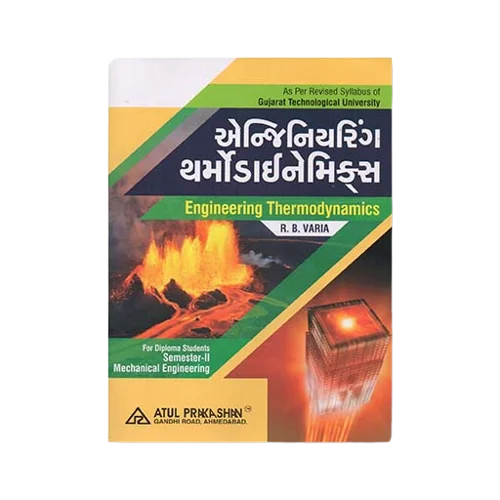
Engineering Thermodynamics
Get the full GTU study material for this subject: official syllabus, textbook links (Gujarati-medium books included where available), and previous year question papers.
GTU Previous Year Papers
Engineering Thermodynamics Syllabus — Unit-wise Content
The official GTU curriculum for Engineering Thermodynamics (subject code 4331902) as prescribed for Marine · Semester 3 divides the course into 5 units, covering 34 listed topics. This curriculum applies from the Aug-2022 intake. The unit-wise breakdown below is read from the GTU syllabus document for this subject code, so you can check what the course actually covers before deciding which papers to attempt.
Download the official syllabus PDF (4331902)Unit 1 Basic Concepts of Thermodynamics 1.a Illustrate various terms related to thermodynamics. 1.b Identify thermodynamic properties with
- 1.1. Introduction and applications of Engineering thermodynamics.
- 1.2. Basic thermodynamic Concepts. - State, System, Boundary and Surroundings. - Types of Systems and boundaries with examples. - Thermodynamic properties, their units and classifications.
- 1.3. Energy, Heat, Work, Power and its simple numericals.
- 1.4. Thermodynamic equilibrium.
- 1.5. Thermodynamic Process and Cycle
- 1.6. Zeroth law of thermodynamics and its application. Engineering Thermodynamics Course Code: 4331902 levels) Topics and Sub-topics
Unit 2 First Law of Thermodynamics 2.a Describe the first law of thermodynamics. 2.b Apply the first law of thermodynamics to real-life situatio...
- 2.1. Law of conservation of energy.
- 2.2. Heat and work relation with Joule’s Experiment.
- 2.3. Statement of the first law of thermodynamics.
- 2.4. Application of the firstlaw of thermodynamics: - Closed system (Non-flowProcesses). - Open system (Flow Processes).
- 2.5. Definition of the flow process, control volume and flow work.
- 2.6. Steady and unsteady flow processes.
- 2.7. Steady Flow Energy Equations (SFEE) and its applications in Nozzle, Diffuser, Boiler, Turbine, Compressor, Condenser, and throttling devices. 2.8Simple numerical examples based on the above.
- 2.9. Identify the applications of First law of thermodynamics for green environment.
Unit 3 Second Law of Thermodynamics 3.a Describe the second law of thermodynamics. 3.b Apply the second law of thermodynamics to real-life situa...
- 3.1. Limitations of the first law of thermodynamics.
- 3.2. Concept of heat source, heat sink, heat engine, heat pump, refrigerator and simple numerical on thermal efficiency and COP (Coefficient of Performance) respectively.
- 3.3. Statement of the second law of thermodynamics: - Kelvin Planck Statement - Clausius Statement
- 3.4. Applications of the second law of thermodynamics.Also identify its applications for green environment.
- 3.5. Concept of reversibility and irreversibility. List of irreversibility only.
- 3.6. Definition of Entropy and its T-ds equation. (Without Derivations)
- 3.7. Statement of the third law of thermodynamics.
Unit 4 Ideal Gases and Thermodynamic Processes 4.a Describe various ideal gas laws. 4.b Derive the relationship of specific heats.
- 4.1. Concept of Ideal gas.
- 4.2. Boyle’s law, Charle’s law and Gay-Lussac law for ideal gases.
- 4.3. Characteristic gas equation and Engineering Thermodynamics Course Code: 4331902 levels) Topics and Sub-topics 4.c Identify various thermodynamic processes. 4.d Calculate the amount of heat transfer, work transfer & internal energy associated with the process. 4.e Plot various thermodynamic processes on P-V and T-S diagrams. 4.f Solve various numerical. Universal gas constant, Specific heats of gas and their relationship.
- 4.4. Thermodynamic Processes, its representation on P-V (Pressure- Volume) and T-S (Temperature-Entropy) diagram: - Constant Volume Process - Constant Pressure Process - Constant Temperature Process - Adiabatic Process - Polytropic Process - Throttling Process
- 4.5. Equations of P-V-T relationship, work transfer, heat transfer and internal energy of the above processes. (Without derivations)
- 4.6. Simple numerical based on the above.
Unit 5 Thermodynamic Cycles 5.a Identify thermodynamic processes in a cycle. 5.b Plot various cycles on P-V and T-s diagram. 5.c Solve various
- 5.1. Classifications of thermodynamic cycle.
- 5.2. Carnot cycle and its representation on P- V and T-s diagram.
- 5.3. Derivation of thermal efficiency of Carnot cycle and simple numerical based on it.
- 5.4. Concept of air standard efficiency.
- 5.5. Otto, Diesel, Dual and Brayton cycle (Without derivation)
- 5.6. Representation on P-V & T-s diagram, Equation of air standard efficiency (Without derivations) and simple examples.
- 5.7. Representation of Reversed Carnot cycle and Reversed Brayton cycle on P-V and T-s diagram respectively.
Study on Android App:
