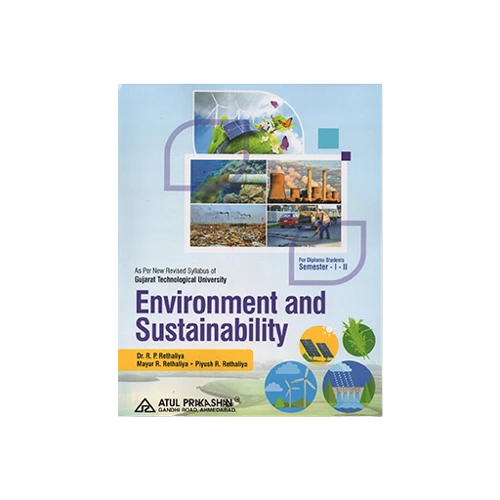
Environment and Sustainability
Get the full GTU study material, English & Gujarati textbook PDFs, syllabus curriculum, and solved previous year question papers.
GTU Previous Year Papers
Environment and Sustainability Syllabus — Unit-wise Content
The official GTU curriculum for Environment and Sustainability (subject code 4300003) as prescribed for Information Technology · Semester 2 divides the course into 5 units, covering 43 listed topics. The unit-wise breakdown below is read from the GTU syllabus document for this subject code, so you can check what the course actually covers before deciding which papers to attempt.
Download the official syllabus PDF (4300003)Unit 1 Ecosystem
- 1.1. Structure and components of ecosystem
- 1.2. Types of Ecosystem, changes in ecosystem
- 1.3. Various natural cycles like carbon, Nitrogen, Sulphur, Phosphorus
- 1.4. Ecosystem conservation, carrying capacity of earth, Biomes in India, (ESA) Ecologically sensitive areas
- 1.5. Bio diversity, its need and importance, International Union for Conservation of Nature (IUCN) red list
- 1.6. Concept of Ecological foot print, virtual water, global ecological overshoot
Unit 2 Pollution and its types
- 2.1. Definition of pollution and pollutant
- 2.2. Air pollution, classification and its sources
- 2.3. Air pollution control Equipments
- 2.4. Water pollution, pollution parameters like BOD,COD, pH, Total suspended solids, Turbidity, Total Solids
- 2.5. Waste water treatment like primary, Environment and Sustainability Course Code: ................. NITTTR Bhopal – GTU - COGC-2021 Curriculum above level) Topics and Sub-topics
- 2.6. Solid waste generation, sources and characteristics of Muncipal solid waste
- 2.7. Collection and disposal of Muncipal waste and Hazardous waste
- 2.8. Noise pollution- its effects, sources and measurement
- 2.9. Plastic waste and its hazard
- 2.10. E waste and its hazard
Unit 3 Renewable sources of energy
- 3.1. Need of Renewable energy and energy policy
- 3.2. Solar energy: National solar mission
- 3.3. Features of solar thermal and PV systems Advanced collector, Solar Pond, Solar water heater, Solar dryer, polycrystalline, monocrystalline and thin film PV systems
- 3.4. Wind Energy: Growth of wind power in India
- 3.5. Types of wind turbines – Vertical axis wind turbines (VAWT) and horizontal axis wind turbines (HAWT)
- 3.6. Types of HAWTs – drag and lift types
- 3.7. Biomass: Overview of biomass as energy source. Thermal characteristics of biomass as fuel
- 3.8. Anaerobic digestion, Biogas production mechanism, utilization and storage.
- 3.9. New energy sources: Geothermal energy, Ocean energy sources, Tidal energy conversion, Hydrogen energy
Unit 4 Climate Change
- 4.2. Definition of climate change
- 4.3. Global warming-causes, effect, process
- 4.4. Greenhouse effect
- 4.5. Ozone depletion
- 4.6. Factors affecting climate change
- 4.7. Impact and mitigation
- 4.8. Climate change management Environment and Sustainability Course Code: ................. NITTTR Bhopal – GTU - COGC-2021 Curriculum above level) Topics and Sub-topics
- 4.1. Identify Factors affecting climate change in given locality.
Unit 5 Environme ntal legislation and sustainable practices 5.a Use relevant policy or law in relation with environment in
- 5.1. Environmental policies in India
- 5.2. Air act, water act, Environment protection act, wild life protection act, Forest conservation act, Biodiversity act
- 5.3. Environmental management system: ISO 14000, definition and benefits
- 5.4. Rain water harvesting
- 5.5. Green building and rating system in India
- 5.6. Cradle to cradle concept and Life cycle analysis
- 5.7. Green label
- 5.8. Carbon credit system its advantages and disadvantages
- 5.9. Concept of 5R(Refuse, Reduce, Reuse, Repurpose, Recycle)
- 5.10. Eco tourism: advantages and disadvantages Note: The UOs need to be formulated at the ‘Application Level’ and above of Revised Bloom’s Taxonomy’ to accelerate the attainment of the COs and the competency.
Study on Android App:
