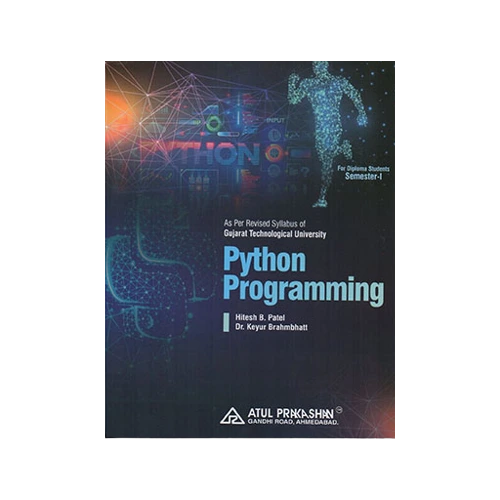
Python Programming
Get the full GTU study material, English & Gujarati textbook PDFs, syllabus curriculum, and solved previous year question papers.
Python Programming Syllabus — Unit-wise Content
The official GTU curriculum for Python Programming (subject code 4311601) as prescribed for Information Technology · Semester 1 divides the course into 5 units, covering 35 listed topics. The unit-wise breakdown below is read from the GTU syllabus document for this subject code, so you can check what the course actually covers before deciding which papers to attempt.
Download the official syllabus PDF (4311601)Unit 1 Problem Solving using Flowchart and Algorithm
- 1.1. Explain steps to solve a problem.
- 1.2. Draw flowchart of given problem based on sequence, selection, repetition.
- 1.3. Write pseudocode for the given problems.
- 1.1.1. Introduction, Steps for problem-solving, Algorithm and its characteristics, Importance of flowchart and algorithm
- 1.2.1. Symbolic representation of a flowchart, Limitations of flowchart Flow of control
- 1.3.1. Problem solving using pseudocode
Unit 2 Python Introduction
- 2.1. Explain the given features and applications of python.
- 2.2. Write steps to Install the latest version of python
- 2.3. Apply given keywords, identifiers, variables, data types, and operators in python programs.
- 2.4. Write pseudocode for the explicit and implicit type conversion.
- 2.1.1. Introduction to python, Python features, Applications of python programming
- 2.2.1. Python installation
- 2.3.1. Basic structure of python program, Keywords, identifiers, and variables, Data types, Operators
- 2.4.1. Type Conversion
Unit 3 Flow of Control
- 3.1. Classify control structure.
- 3.2. Write pseudocode for the flow of control using different selection types.
- 3.3. Write pseudocode for the flow of control using different repetition types.
- 3.4. Implement break and continue statements in the python program.
- 3.1.1. Introduction to Flow of Control
- 3.2.1. Selection - If statement - Elif statement - Nested if statement
- 3.3.1. Repetition - For loop - While loop - Nested loop
- 3.4.1. Break and Continue Statements
Unit 4 Functions
- 4.1. Write pseudocode for user- defined functions.
- 4.2. Apply Global and Local variable concepts in python program.
- 4.3. Use built-in functions and modules.
- 4.1.1. Introduction to Functions - User Defined Functions - Arguments and Parameters 4.2.1Scope of a Variable - Global Variable - Local Variable Python Programming Course Code: 4311601 NITTTR Bhopal – GTU - COGC-2021 Curriculum Topics and Sub-topics
- 4.3.1. Python Standard Library - Built-in functions - Input or output - input() , print() - Mathematical Functions - abs(), divmod(), max(), min(), pow(), sum() - Module - math - random - statistics
Unit 5 Strings and Lists
- 5.1. Use of string operations in python programs.
- 5.2. Use built-in functions for string manipulation.
- 5.3. Write pseudocode for list operations.
- 5.4. Use built-in functions for list manipulation.
- 5.1.1. Introduction to Strings, String Operations, Traversing a String
- 5.2.1. Strings Methods and Built-in Functions
- 5.3.1. Introduction to List and its Operations
- 5.4.1. List Methods and Built-in Functions - Nested and Copying Lists - List as Arguments to Function
Study on Android App:
