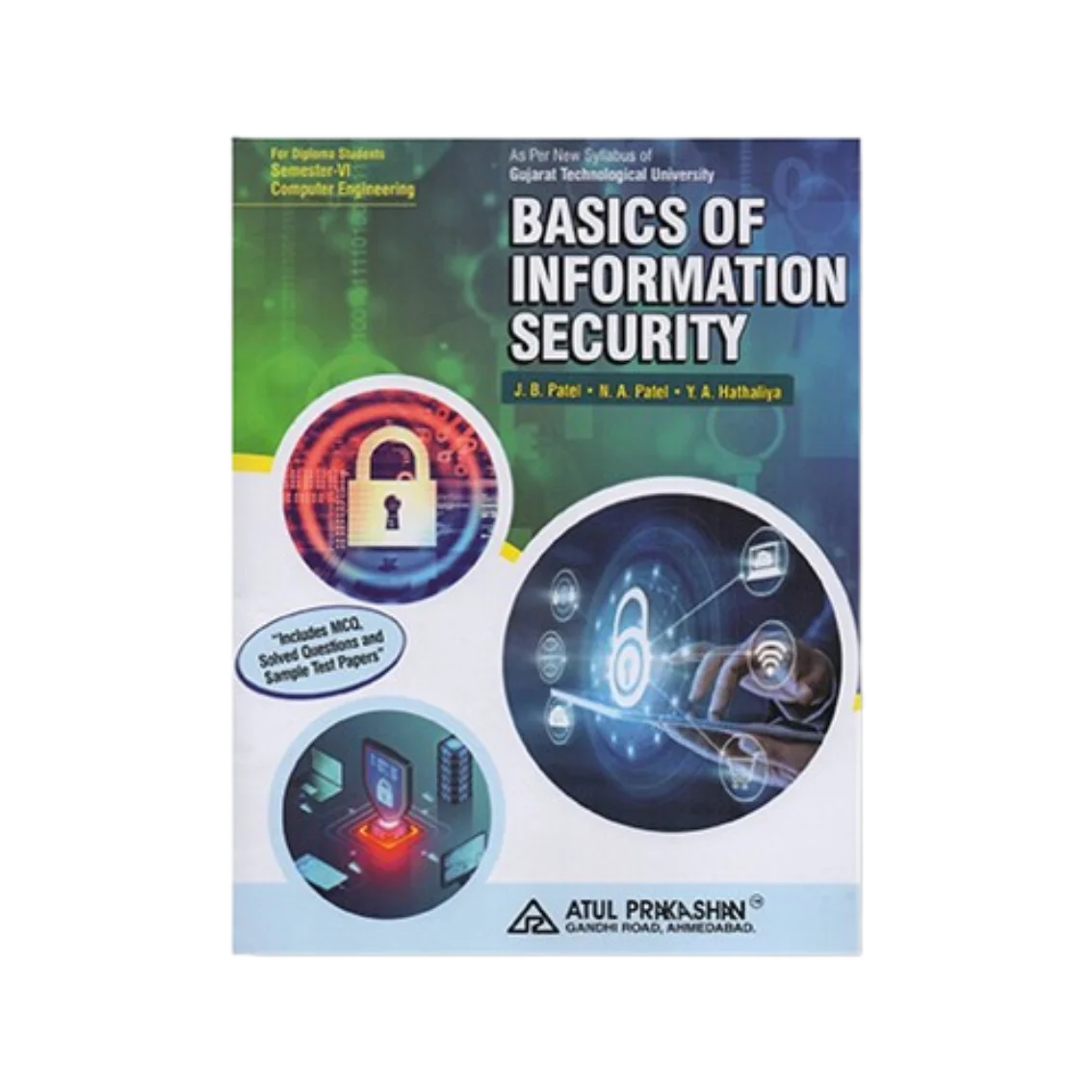
Basics of information Security
Get the full GTU study material for this subject: official syllabus, textbook links (Gujarati-medium books included where available), and previous year question papers.
Basics of information Security Syllabus — Unit-wise Content
The official GTU curriculum for Basics of information Security (subject code 4360702) as prescribed for CSE · Semester 6 divides the course into 4 units, covering 17 listed topics. This curriculum applies from the 1/1/2025 12:00:00 AM intake. The unit-wise breakdown below is read from the GTU syllabus document for this subject code, so you can check what the course actually covers before deciding which papers to attempt.
Download the official syllabus PDF (4360702)Unit 1 Introduction to Information Security 1.a Describe basic concept of Information Security and security attacks
- 1.1. Introduction to Information Security
- 1.2. Need for Security
- 1.3. Security Attacks : Active, Passive and Denial of Service
- 1.4. Security Basics : Confidentiality, Integrity and Availability
- 1.5. Services and Mechanisms
Unit 2 Conventional and Symmetric Cryptography 2.a Encrypt and Decrypt the given text using different substitution methods. 2.b Describe the giv...
- 2.1. Introduction: Plain text, Cipher text,Cryptography, Cryptanalysis, Cryptology, Encryption and Decryption.
- 2.2. Substitution and Transposition Techniques:Monoalphabetic Cipher,CaesarCipher, Polyalphabetic Cipher, Playfair Cipher, Hill Cipher, One Time Pad, Rail fence
- 2.3. Steganography: Introduction, Types of steganography techniques
- 2.4. Symmetric Cryptography : Data Encryption Standard- Structure, Advantages and Disadvantages
Unit 3 Public key Cryptograph y 3.a Describe Public- Key Cryptography and its applications. 3.b Describe the RSA algorithm with its working.
- 3.1. Public-Key Cryptography : Principles of public-key cryptosystems, Applications of Public-key cryptosystems
- 3.2. The RSA algorithm: Description of the Algorithm, Computational aspects, Security of RSA.
- 3.3. Public key infrastructures : basics digital signatures, digital certificates,certificate authorities,registration authorities, steps for obtaining a digital certificate, steps for verifying authenticity and integrity of a certificate Basics of Information Security Course Code: 4360702 Unit– IV Networ k Security 4.a Describe the security topologies. 4.b Explain function of Firewall and different types of Firewall. 4.c Distinguish various types of IDS with advantages and disadvantages.
- 4.1. Security topologies – security zones, DMZ, Internet, Intranet, VLAN, Security implication, Tunneling.
- 4.2. Firewalls: Need of Firewall, Working of Firewall, Types of Firewall: Packet Filtering, Stateful Inspection, Application Level Gateway, Circuit-Level Gateway and Next-Generation Firewall
- 4.3. Intrusion detection systems (IDS): Intruders, Components of IDS, Host based IDS: Host based IDS, Advantages and Disadvantages of HIDS, Network based IDS: Network IDS, advantages and disadvantages of NIDS
Unit 4 Cyber Security 5.a Describe basic concepts of cyber security and Network threats. 5.b Describe Cyber crime and problems associated with c...
- 5.1. Introduction to Cyber Security, Cyber Threats, Types of Cyber Attacks, Vulnerabilities, Intruders and Hackers, Threats: Worms, Virus, Ad- ware, Spy- ware, Trojans and covert channels, Backdoors, Bots, IP Spoofing, ARP spoofing, Session Hijacking
- 5.2. Cyber Crimes, Types of Cybercrime, Hacking, Attack vectors, Cyberspace and Criminal Behavior, Traditional Problems Associated with Computer Crime Note: The UOs need to be formulated at the ‘Application Level’ and above of Revised Bloom’s Taxonomy’ to accelerate the attainment of the COs and the competency.
Study on Android App:
