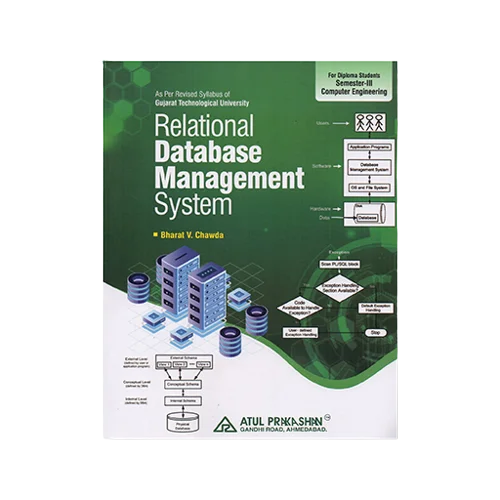
Relational Database Management System
Get the full GTU study material, English & Gujarati textbook PDFs, syllabus curriculum, and solved previous year question papers.
Relational Database Management System Syllabus — Unit-wise Content
The official GTU curriculum for Relational Database Management System (subject code 4330702) as prescribed for COMPUTER · Semester 3 divides the course into 5 units, covering 32 listed topics. The unit-wise breakdown below is read from the GTU syllabus document for this subject code, so you can check what the course actually covers before deciding which papers to attempt.
Download the official syllabus PDF (4330702)Unit 1 Introduction to Database System and SQL commands
- 1.1. Concepts and Definitions: Database and database systems and database environment
- 1.2. Data, Information, Data Item or Fields, Records, Files, Metadata, Data dictionary and it’s components,
- 1.3. Schemas, Sub-schemas, and Instances
- 1.4. Data types
- 1.5. Database Language commands: Data Definition Language (DDL): CREATE, ALTER, TRUNCATE, DROP
- 1.6. Database Language: Data Manipulation Language (DML): INSERT, SELECT, UPDATE, DELETE
- 1.7. Transactional Control: Commit, Save point, Rollback
- 1.8. DCL Commands: Grant and Revoke
Unit 2 SQL In built functions and Joins
- 2.1. Operators Arithmetic, Comparison, Logical SQL functions- Single row function i. Single row function. ii. Date functions (add-months, months-between, round, truncate). iii. Numeric Functions (abs, power, mod, round, trunc, sqrt) iv. Character Fucntions (initcap, lower, upper, ltrim, rtrim, replace, substring, instr) v. Conversion Functions (to-char, to- date, to-number)
- 2.5. Implementation of Queries using SQL Set operators: Union, union all, Intersect, Minus
Unit 3 Database Integrity Constraints & Objects
- 3.1. Domain Integrity constraints: Not null, Check
- 3.2. Entity Integrity constraints: Unique, Primary key.
- 3.3. Referential Integrity constraints: Foreign key, referenced key, on delete cascade
- 3.5. Synonym: Create, Drop synonym
- 3.6. Sequences: Create, alter, Drop sequences
- 3.7. Index: Unique and composite – Create, Drop
Unit 4 PL/ SQL and Triggers
- 4.1. Basics of PL / SQL
- 4.1.1. Data types
- 4.2. Advantages of PL/SQL over SQL
- 4.3. Control Structures: Conditional, Iterative, Sequential
- 4.4. Exceptions: Predefined Exceptions, User defined exceptions
- 4.5. Cursors: Static (Implicit & Explicit), Dynamic
- 4.6. Procedures & Functions
- 4.7. Fundamentals of Database Triggers
- 4.8. Creating Triggers
- 4.9. Types of Triggers: Before, after for each row, for each statement
Unit 5 Normalization
- 5.1. Basics of Normalization
- 5.2. Normal Forms
- 4.2.1. First Normal Form(1NF)
- 4.2.2. Second Normal Form(2NF)
- 4.2.3. Third Normal Form(3NF)
- 5.3. Advantages and disadvantages of Normalization Note: The UOs need to be formulated at the ‘Application Level’ and above of Revised Bloom’s Taxonomy’ to accelerate the attainment of the COs and the competency. Relational Database Management Systems Course Code: 4330702
Study on Android App:
