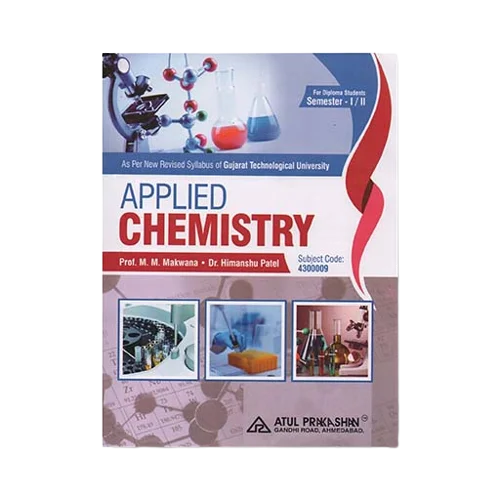
Applied Chemistry
Get the full GTU study material, English & Gujarati textbook PDFs, syllabus curriculum, and solved previous year question papers.
Applied Chemistry Syllabus — Unit-wise Content
The official GTU curriculum for Applied Chemistry (subject code 4300009) as prescribed for CIVIL · Semester 2 divides the course into 7 units, covering 54 listed topics. The unit-wise breakdown below is read from the GTU syllabus document for this subject code, so you can check what the course actually covers before deciding which papers to attempt.
Download the official syllabus PDF (4300009)Unit 1 Atomic Structure, Chemical Bonding and Solutions
- 1.1. Atomic Structure: Concepts of orbit and orbital, Pauli’s exclusion principle.
- 1.2. Hund’s rule of maximum multiplicity,
- 1.3. Aufbau rule, electronic configuration of atom (up to atomic number 30)
- 1.4. Chemical Bonding: Concept of chemical bonding, types of chemical bonds, Ionic bond, and its characteristics (example NaCl), Covalent bond and its characteristics (example H2, O2, N2, HF, NH3, H2O, CH4), Coordinate covalent bond (example NH4+, H3O+
- 1.5. Molecular arrangement in solid, liquid, and gases, Structure of solids - Molecular solid, Ionic solid, Network solid, and Metallic solid. ), Metallic bond and its characteristics, Hydrogen bonding, its types, and Significance, Intermolecular force of attraction.
- 1.6. Solutions: The idea of solute, solvent, and solution, Methods to express the concentration of solution - Normality, Molarity (M = mole per liter), ppm, mass percentage, volume percentage, and mole fraction.
Unit 2 Concepts of Electrochemistry
- 2.1. Arrhenius theory of ionization.
- 2.2. Electronic concept of oxidation, reduction, and redox reactions.
- 2.3. Degree of ionization and factors affecting the degree of ionization.
- 2.4. Definition of pH, pH of acid, base Applied Chemistry Course Code: 4300009 NITTTR Bhopal – GTU - COGC-2021 Curriculum buffer solutions and their application.
- 2.5. Definition of buffer solution, buffer action and types of buffer solution, Application of buffer solution.
- 2.6. Definition of terms: electrolytes, non-electrolytes with suitable examples, Types of electrolytes.
- 2.7. Construction and working of Electrochemical Cell.
- 2.8. Construction and working of Standard Hydrogen Electrodes (SHE).
- 2.9. Nernst theory of single electrode potential and Nernst equation.
- 2.10. Electrochemical series.
- 2.11. Electrolysis, Faraday’s laws of electrolysis,
- 2.12. Industrial application of electrolysis: Electrometallurgy, electroplating, electrorefining.
Unit 3 Corrosion of metals and its prevention
- 3.1. Corrosion: Dry or Chemical corrosion: Oxidation corrosion- mechanism, Corrosion by other gases.
- 3.2. Wet or Electrochemical corrosion- H2 liberation and O2
- 3.3. Galvanic corrosion mechanism. absorption mechanism of electrochemical corrosion.
- 3.4. Concentration cell corrosion.
- 3.5. Pitting corrosion, Waterline, and Crevice corrosion.
- 3.6. Factors affecting the rate of corrosion: Nature of the metal, Nature of surface film, Relative areas of the anodic and cathodic parts, Purity of metal, Temperature, Humidity of air, Influence of pH.
- 3.7. Internal and external corrosion preventive measures: Modification Applied Chemistry Course Code: 4300009 NITTTR Bhopal – GTU - COGC-2021 Curriculum of environment, Modification of the properties of metal, Use of protective coatings, Anodic and cathodic protection, Modification in design, and choice of material.
Unit 4 Water
- 4.1. Introduction, Source of water, Hard water and soft water.
- 4.2. Salts cause water hardness, Unit of hardness, and simple numerical on water hardness.
- 4.3. Problems caused by the use of hard water in boilers and its prevention.
- 4.3.1. Scale and sludge, Foaming and Priming, Caustic embrittlement, Corrosion
- 4.4. Water softening techniques: Soda- lime process, Zeolite process, Ion exchange process, Reverse Osmosis process (R.O.)
- 4.5. Treatment of Municipal drinking water: Screening, Sedimentation, Coagulation, Filtration, Sterilization of water by chlorination, Break- point of Chlorination.
- 4.6. Enlist Indian standard specifications of drinking water.
Unit 5 Cements, Glasses and Refractories
- 5.1. Cement, constituting compounds in cement.
- 5.2. Composition and manufacture of Portland cement.
- 5.3. Setting and hardening of cement.
- 5.4. Glass and its general properties.
- 5.5. Manufacture of glass, variety of glasses and their application.
- 5.6. Definition of refractories.
- 5.7. Characteristics and Application of refractories.
- 5.8. Classification of refractories: Acid, Basic and neutral refractories.
Unit 6 Paints, Varnishes and Insulating Materials
- 6.1. Definition of paints, the purpose of oil paints, characteristics of oil paints.
- 6.2. Ingredients of paints: Function and example of each ingredient.
- 6.3. Varnishes: Types of varnishes, Applied Chemistry Course Code: 4300009 NITTTR Bhopal – GTU - COGC-2021 Curriculum insulating materials based on their properties. Differentiate between paints and varnishes.
- 6.4. Insulating materials: Types and properties of Insulating materials.
- 6.5. Application of Thermal, Acoustic, Waterproofing, and Fireproofing insulating materials.
Unit 7 Polymers, Elastomers, and Adhesives
- 7.1. Definition of Monomer, Polymer, and Polymerization.
- 7.2. Classification of Polymers based on molecular structure: Linear Polymers, branched polymers, Cross- linked polymers.
- 7.3. Classification of polymers based on Monomer: Homopolymer, Copolymer.
- 7.4. Classification of polymers based on thermal behavior: Thermoplastics and Thermosetting polymers.
- 7.5. Types of polymerizations: Addition and condensation polymerization
- 7.6. Simple reactions involved in the preparation and their properties and application of thermoplastics and thermosetting polymers: Polyethylene, Polypropylene, Polyvinylchloride, Polytetrafluoroethylene (Teflon), Polystyrene, Polyacrylonitrile, Bakelite, Epoxy resins
- 7.7. Biodegradable Polymers: Introduction, chemical composition, and application: Polyβ- hydroxybutyrate–co-β-hydroxy valerate (PHBV), Nylon-2–nylon-6.
- 7.8. Rubber: Natural rubber and its properties, Vulcanization of rubber, Synthetic rubber – simple reaction involved in the preparation and their properties and application: Buna-S rubber, Buna-N rubber, Neoprene rubber
- 7.9. Adhesives: Characteristics, Classification and application of adhesives. Applied Chemistry Course Code: 4300009 NITTTR Bhopal – GTU - COGC-2021 Curriculum
Study on Android App:
